Showing posts with label Mark Pallen. Show all posts

Thursday, 20 April 2023

When the Old Man Died, 19th April


And he had a tin ear...

You’d think by the photo above that he was never young, but a scurrilous lecture by Prof. Mark Pallen shows what he got up to when he was a beardless youth.  That was given at Mark’s ‘Darwin Day 2020’ event; I got to give a talk at this year’s event on the subject ‘Darwin, DNAand Music’. More revelations about what Darwin got up to as a youth can be seen in this excellent skit by Prof. Pavel Borodin’s wonderful students at the Centre for Cytology and Genetics, University of Novosibirsk. Wow, Charlie was young once! And get a load of the marvellous intro song by Suzi Quatro, written around the 100th anniversary of him popping his clogs, I can almost hear him humming along.

Yes, all good things come to an end and 19th April 1882 was the end of that particular 3 Billion year-old twig of the Tree of Life (his beautiful image of all our connection). On 10th March I posted an extract from ‘Three Soliloquies’, an arc of extracts from his life and travels starting with ‘The Gloriesof the Vegetation of the Tropics’, from ‘Voyage of the Beagle’. That was the young Darwin. The third section is ‘A Man Looks Forwards and Backwards’ (with a slight edit-out for musical reasons) and you can listen to an extract here. I’d love to get this recorded as it’s ready-to-go and ‘approved’ by a professional singer and classical guitarist, but at present is only in rendition form. I’m on the look-out for concert promoters who fancy a bit of serious baritone/guitar combo. So in the meantime, you can be amongst the first to sing it, if you follow the words below, from ‘Autobiography’

Extract of baritone / c. guitar aria, David F. Gahan


"A man (on the other hand) looks forwards and backwards, and compares his various feelings, desires and recollections. He then finds, in accordance with the verdict of all the wisest men that the highest satisfaction is derived from following (certain impulses, namely) the social instincts..." 

This is an older Darwin, reflecting on life and what really matters. We leave him ascending the holy mountain - not of Sion, but of Science.

Picture credits:

Darwin College publicity for ‘The Darwins & Music’

Music extract copyright David. F. Gahan


Sunday, 12 February 2023

33-and-Me, Darwin Day, Suzi Quatro – and good luck in Novosibirsk!


Suzi Quatro - godmother of Rock and Charles Darwin fan

Happy Darwin Day – what a good time of year for the Great Man to be born, just two days before that festival of the reproductive urge, Valentine’s Day – a happy time of year with snowdrops and daffodils beautifying our Northern Hemisphere spring. 

At the last count, I was pleased to see 33 events posted on the International Darwin Day website, plus the one I’m speaking at, and playing some music, at the University of East Anglia Quadram Institute in Norwich, England on Monday 13th (couldn’t resist the 33andMe ‘genetic’ pun, but I believe I don’t have more than the usual 23 pairs of chromosomes). As part of the talk on Darwin, DNA & Music, I’ll be playing Dave Deamer’s transcription of the gene coding for the two chains of the Insulin protein, you can listen to that here. This was featured in Dave’s amazing Wonderfest talk and he’s the grand-daddy of DNA music.

The value of international cultural efforts around Darwin and Evolution in our modern liberal, science-respecting culture is pretty high, and what wonderful opportunities and linkages can arise from them. How else would a 1991 tribute to Charles Darwin via ‘godmother of Rock’ Suzi Quatro, via Darwin Day celebrations in Novosibirsk, Russia have led to a a good chance to share Darwin-music in Norwich?

This is funny. One of the first two events posted for IDD was from the Institute of Cytology and Genetics in Novosibirsk – well known stop on the Trans-Siberian railway and a university town. Professor Borodin (no relation to the great composer and chemist whose chain-lengthening reaction pathway is an essential tool in organic synthesis) has been a champion of civilised celebration of IDD for years. We had a nice email exchange and he sent some links of the amazing Darwin tributes and mocumentaries his students have produced some years. Three cheers for civilised science students everywhere, especially musically engaged. 

If you want tears of laughter to flow down your cheeks, get a load of this biopic. I never knew he had so much trouble with those finches! And some very subtle jokes – I’m on your wavelength guys. But imagine my surprise at the opening musical number – Queen Suzi!

Hey Charley, Hey Charley
Did your mind tell your heart what to do
Hey Charley, Hey Charley
Did you know that the world would be looking at you
Ooooh, the way that they do

Where did they find that? I had to know, went googling – but someone had been on the trail before me. Step forward Professor Pallen, microbial geneticist and ruck’n’dubfan. Wow! Someone else on the Darwin music trail. If you want the full low-down on how Suzi Q came to be ‘Number 1 in the Darwin Charts’, read Mark’s entry from his Rough Guide to Evolution. So that’s how I come to be speaking at his Uni for this year’s Darwin Day. 


Picture Credit Suzi Quatro website 

Thursday, 2 February 2023

Good Luck: In This Brief Moment, Darwin cantata by Brett Dean


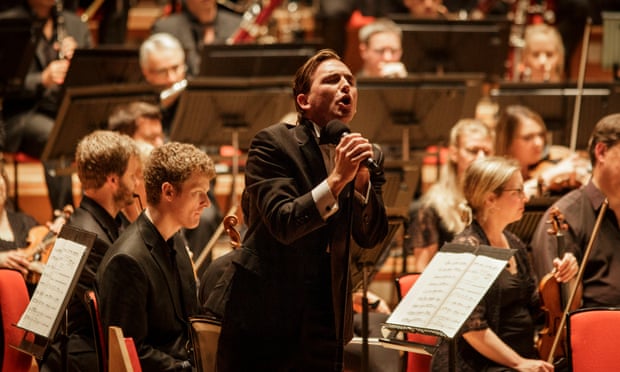
Counter-tenor Patrick Terry giving it everything, with CBSO

In a blog dedicated to Evolution & Music, it’s good to note a new substantial work adding to the growing canon of Darwin related music. Today, 02/02/2023 (proximal to InternationalDarwin Day ~ 12th Feb, now up to 34 events) sees the second performance of In ThisBrief Moment, following its worldwide première in Birmingham on 24/09/2022. I only found out about it from Mark Pallen while arranging the talk I’m due to give on Monday 13th Feb in Norwich on ‘Darwin, DNA & Music’ (for free registration, if you can make it, book here). So maybe there is a need for a blog on Darwin/Evolution Music!

So, lucky few who attended at Birmingham and tonight’s concert in Hamburg! (including Prague Philharmonic Choir / NDR Elbphilharmonie Orchester). An enthusiastic review in the Guardian made the piece sound fun, with a good mix of ingredients as one would expect from a modern synthesis. Dean, based in Germany and also wielding a mean viola and conductor’s baton is (maybe!) Australia’s leading composer; he certainly knows what an orchestra is for, as a few moments listening to any of his available clips will show. It’s perhaps unfortunate that for this subject with potentially wide appeal, it isn’t yet ‘for sharing’, so we’re left with only the reviews and a list of ingredients. I’ll try and find out more.

But it seems like a lot was packed into 45 minutes: “moments of extreme beauty”in the intertwining of the soloists lines, zany cabaret sequence, recorded voiceover and “extraordinary chirruping” sounds made by 24 specially created whirlytubes, and the choir donning black masks, presumably in an ecological connection. I’m all in favour of serious artistic works using visuals, props and even audience participation (just you wait…).

And a nod to that greatest, so far, of all the stories of our Origin told in music, Haydn’s Creation. I sang this with a Parisian choir in 1996, somewhere on the Left Bank. Oh for a Darwin-based work to hold a candle to that… I look forward to hearing Brett’s work and hearing how it holds up.

Picture credit: Guardian Newspapers

Thursday, 26 January 2023

The Super Ape: date change!


...Is Us. Reggae, Dub & performance poetry below

Last post, I’d just been asked to give a talk for International Darwin Day at the University of East Anglia, Norwich, Quadram Institute on 13th Feb (date change from 10th due to INDUSTRIAL ACTION). This free event has now been posted (LINK SHOWS INCORRECT DATE, but booking site will be fine) as one of seventeen events from Brazil, Mexico (US x 8), through Germany and Novosibirsk, Russia (more on this excellent group later). I’ll be giving a talk inspired by the cult classic Gödel, Escher, Bach (Hofstadter, 1979) - about codes in music and how DNA can be represented, drawing on other composers’ efforts and using a useful trick from my biochemical past! A fair amount of genetics with a bit of music-theory added. I’ll be posting a new music video on Soundcloud to mark the occasion.

The event, organised by Profs. Tracey Chapman & Mark Pallen, will feature talks on “The ghost in the garden: in search of Darwin’s lost garden” (Dr Jude Piesse) and “The Call of the Wild: the genomic history of wolves and dogs” (Dr Anders Bergstrom). Mark is an international expert on high-throughput sequencing to problems in microbiology and ancient DNA research, and old hand at giving popular lectures on Darwin & Evolution. Here’s a saucy one from the Institute’s 2020 Darwin Day events, giving all the scuttlebutt (lovely American term) you’ll ever need on C.D. He’s also the author of the Rough Guide to Evolution (2008) which contains a section on music related to Darwin. A lot has happened since 2008 (stimulated by the 150th anniversary of ‘Origin’ in 2009) so probably will need an update; but in the meantime it’s a main theme of this blog so keep on reading!

One delight of finding all this science-arts-culture fostered by Tracey & Mark at Quadram was discovering performance poet (& science-writer, &&&…) Peter Bickerton, the Juggling Doctor. Peter gave a great reading of his piece Super Ape at Quadram in 2019, a video of it here. Wow, in a grand sweep (see my blog entry Arthur C. Clarke for comparison), he arcs our story from big-bang to extinction. Millenial-millenarianism?  Why not? Of course it’s painted in topical concerns, images and thought-patterns of our age (whadja want? Biblical style?), but that’s what gives it colour and fun; oh, and the really cool Jamaican Reggae / Dub from The Upsetters (1976). In a blog whose twin themes are evolution and music this was a great find. I’ll post at a later date about more Evolution-Dub!


Where do you look for E.T.? My paper on just that published in Acta Astronautica

  Published in Acta Astronautica June 2025, open access till end July Can there be any answer to that question that makes sense? We’ve been ...