Showing posts with label Darwin College. Show all posts

Sunday, 9 April 2023

Happy Easter, Librarian!


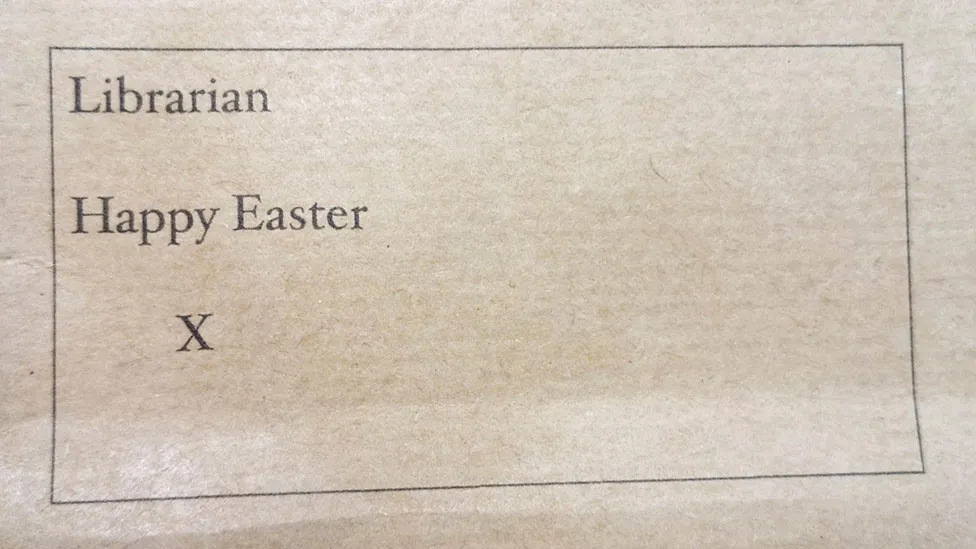
Mysterious Message, left by the perpetrator

A remorseful thief repented last Easter (2022) and made amends. Whatever selfish urges which prompted them to plunder Cambridge University Library, appropriating for personal pleasure part of our common historical patrimony, was expiated in an act of remorse and restitution. Wow! - one doesn’t usually get to use words like those in a blog dedicated to science. But my guess is that the perpetrator was probably steeped in such language – it was Cambridge after all, and the Easter message is a bit tell-tale.

And a great joy it was to anyone interested in the culture and history of science! (To hard scientists, it’s the idea, not the original physical manifestation in ink and paper, that’s the thing.) The story is well told here and the joy that all-manner-of-things-were-wellis communicated in a video interview by Chief Librarian Dr Jessica Gardner. The timing was also a marvel, being in the final year of the Darwin Correspondence Project, a titanic effort to put 15,000 items of correspondence on line (I used it today!).

And such was that joy that, with a little persuading and ideation with a young historian of science academic at Darwin College, Edwin Rose, that the idea of a celebratory concert was born, including my string quartet on Darwinian themes. CUL via the Darwin Correspondence Project stumped a little money which gave rise to the concert which began this blog. It is sanely difficult to get new music programmed /performed from an unusual source. Sanely? Yes, because of the vast back-catalogue, and perfectly proper (albeit mean) funding/support structures for contemporary professional composers. So, usually, no chance to get music like this performed.

The concert, superbly programmed by Francis Knights, took place on 29th October 2022. It was a great chance to visit the exhibition of DCP at the Library – wonderful, touching examples of the correspondence, including with the fine minds in the British Public at the time such as the Stonemason’s letter (your time will be richly rewarded by clicking on this). The exhibition is now moving to the New York Public Libraries and runs through the summer.

So it is with thanks to the Repentant Thief, CUL and DCP, and Darwin College for the opportunity to visit the exhibition and to have a funded performance of Eyenigma Variations. See Darwiniana tab for photos, quotes and links to the music. I will post more music next time, related to Darwin’s examinations of coral reefs!

And Happy Easter to you; we come from many traditions and all are to be valued, examined, and celebrated.


Wednesday, 16 November 2022

Eyenigma Variations – Extract on Soundcloud!

Following the marvellous performance of Eyenigma Variations at Darwin College Cambridge on 29th October by a quartet led by Paul Warburton, I’ve had many requests to hear the piece.  The concert ‘The Darwins and Music’ was a miracle of organisation with so many memorable elements – but too complex for a recording to take place, or to be fair to the musicians who gave their time serving up this wonderful collection of Darwin-related music.

Now Eyenigma has had its public premier, in the company of pieces by Cheryl Frances-Hoade, Haydn, Fanny Mendelssohn, Frédéric Chopin and Ralph Vaughan-Williams, it’s probably time to put and extract on Soundcloud (‘robot rendition’ directly from the software).  I’ve chosen the smokey ‘Tranquillo’ section through to the frenetic end, with warring codes and a final genetic STOP!  You’ll miss out on the mysterious beginning ‘Morse Codes and Torchbeams’ (flashlights!) and Variations on an anti-evolution hymn, but so soon after hearing flesh-and-blood musicians bring the whole thing to life I haven’t the heart to let the robots play the whole thing.

The Tranquillo is one of my favourite sections.  It was originally a vocal passage setting Darwin’s words describing how the Eye might have come to be, “from one very imperfect and simple” and so gets a very simple and calm melody.  The ‘cello comments on this and then adds the genetic code setting of the Eye protein rhodopsin, eventually rising up the scale – of complexity?  The violent and feroce coda reprises all the themes, but just audio lacks the fun of seeing the quartet really physically attacking the last few bars!

Hopefully if this gets a few hits (and comments!) I’ll add more clips to Soundcloud, including the (rendered) vocal/classical guitar settings “Glories of the Vegetation of the Tropics”, “I Gradually Came to Disbelieve” etc, and maybe some of the larger works.


Picture credit: Roland Deschain

Tuesday, 1 November 2022

'The Darwins and Music' - what a concert! 29/20/22


David with quartet members Paul, Bruce, Juliet, Helen and concert organiser Francis Knights


Fabulous concert ‘The Darwins and Music’ at Darwin College, Cambridge on Saturday 29th October, brilliantly put together by historian of science Edwin Rose and Francis Knights, head of music at the college. So many wonderful choices of music to illustrate talks on various Darwin generations, and great performances by the string quartet, Trinity Street Consort (led by Tammas Slater), Carola Darwin (soloist) and Marie-Noëlle Kendall (piano).

The quartet (Paul, Bruce, Juliet and Helen) gave the first public performance of Eyenigma Variations to a capacity audience of ~200 and played with great spirit and physicality, from the mysterioso beginning (the mystery of how Evolution could account for The Eye) to the ff feroce (fierce…) final bars, closing the argument. Given the fabulous other music on offer, from Cheryl Frances-Hoade and Francis Knights to Chopin and Vaughan-Williams (a Wedgewood-Darwin), I was delighted with the excellent performance and with the audience reaction.

I'd taken the opportunity earlier to go round the Darwin Correspondence Project exhibition at Cambridge University Library (joint sponsors of the concert) to see absolute gems of letters and communications casting a lovely light on this most likeable of scientists, the fascinating intellectual web of which he was the centre and his relations with family and the public (and also the famous Tree of Life - purloined & returned! - notebooks). I hope I’ve done some justice to the human aspects that came across in the letters in my ‘Three Soliloquies’ for baritone and guitar (see Darwiniana tab).

NB: no recording was possible due to the complexities and multi-strand nature of the concert.


Thursday, 20 October 2022

Eyenigma Variations first public performance


Eyenigma Variations: first public performance Saturday 29th October 2022 at Darwin College Cambridge

I'm delighted to say that the first public performance of 'Eyenigma Variations' (1.1) will take place at: The Darwins and Music: A Concert (Darwin College), Cambridge University Library as part of and with the support of Cambridge University Libraries exhibition, Darwin in Conversation: The Endlessly Curious Life and Letters of Charles Darwin (Saturday 9 July-Saturday 3 December). 

If you are attending and want to hum along with some of the sections based on Chapter 6, 'Origin of Species' (First Edition), the phrases depicted in music are: 

"Difficulties on the theory"- this becomes an opening rhythm in 'Morse Code': you can mutter along to this in a worried fashion. 

"To suppose that the eye with all its inimitable contrivances [pizzicato] for adjusting the focus to different distances, for admitting different amounts of light, and for the correction of spherical and chromatic aberration, could have been formed by natural selection, seems, I freely confess, absurd in the highest degree. [dance] Yet reason tells me, that if numerous gradations from a perfect and complex eye to one very imperfect and simple, each grade being useful to its possessor, can be shown to exist... [tranquillo]

."..the difficulty of believing that a perfect and complex eye could be formed by natural selection...and may we not believe that a living optical instrument might thus be formed as superior to one of glass, as the works of the Creator are to those of man? [coda]

It's 'music a scientist might write': I hope you like it.

Where do you look for E.T.? My paper on just that published in Acta Astronautica

  Published in Acta Astronautica June 2025, open access till end July Can there be any answer to that question that makes sense? We’ve been ...