Showing posts with label DNA music. Show all posts

Friday, 9 June 2023

Lampyris Noctilucae: Glowworms


Glowworms at work

In June 1832, Charles Darwin was exploring the Brazilian Coast. From ‘The Voyage of theBeagle’ (p29):

“At these times the fireflies are seen flitting about from hedge to hedge. On a dark night the light can be seen at about two hundred paces distant. It is remarkable that in all the different kinds of glowworms, shining elaters, and various marine animals (such as the crustacea, medusae, nereidae, a coralline of the genus Clytia, and Pyrosma), which I have observed, the light has been of a well-marked green colour. All the fireflies, which I caught here, belonged to the Lampyridae (in which family the English glowworm is included), and the greater number of specimens were of Lampyris occidentalis. I found that this insect emitted the most brilliant flashes when irritated: in the intervals, the abdominal rings were obscured. The flash was almost co-instantaneous in the two rings, but it was just perceptible first in the anterior one. The shining matter was fluid and very adhesive: little spots, where the skin had been torn, continued bright with a slight scintillation…” Much follows about the behaviour of the insects. Darwin, ‘The Man Who Walks with Henslow’, was a beetle expert from his Cambridge days and gave a proof of his zeal in Autobiography: “one day, on tearing off some old bark, I saw two rare beetles, and seized one in each hand; then I saw a third and new kind, which I could not bear to lose, so that I popped the one which I held in my right hand into my mouth. Alas! it ejected some intensely acrid fluid, which burnt my tongue so that I was forced to spit the beetle out, which was lost, as was the third one.”

It's strange that, although in the opposite hemisphere, it’s now also our (British/Irish Isles) season for glowworms, as it is for fireflies where I used to live in upstate New York. I once flew from Midsummer’s Day in N.Y. to Midwinter’s Day in Brasilia and found it the same temperature, 26C, so that may have something to do with it. I’ve only ever come across glowworms once in England, on the Cotswold scarp in Gloucestershire, but there’s a splendid website which will give you a start at UK Glow worm survey home page.

I learned about the enzymatic production of light via luciferase in my biophysics classes at Imperial under Dr Nick Franks, who also ‘sparked’ my interest in rhodopsin – the basic photoreceptor in almost every eye - which became the basis for the genetic code theme in Eyenigma Variations. So, a light emitter and a light receiver, both of use to our beautiful summer glowworms and suitable to celebrate in music.

Another musical fan of these ‘living lamps’ and ‘country comets’ was the composer Richard  Rodney Bennett in his suite ‘The Insect World, setting a lovely poem from Andrew Marvell (period of King Charles II) celebrating haymaking time and his beguiling love Juliana. My wife used to sing this in girls’ choir under the amazing Mr Smith at Ross-on-Wye Grammar in the 1970s. Here’s a recording of an orchestral version with its lovely melody. I’ve not been able to resist doing a setting for classical guitar and solo voice using RRB’s amazing jazz inspired chords - but I’ll need RRB’s estate’s permission to perform it publicly. But here’s the start.

My setting of RRB's 'Glowworms'


Picture credits: Universal Editions; David Gahan (copyright for that arrangement)


Sunday, 9 April 2023

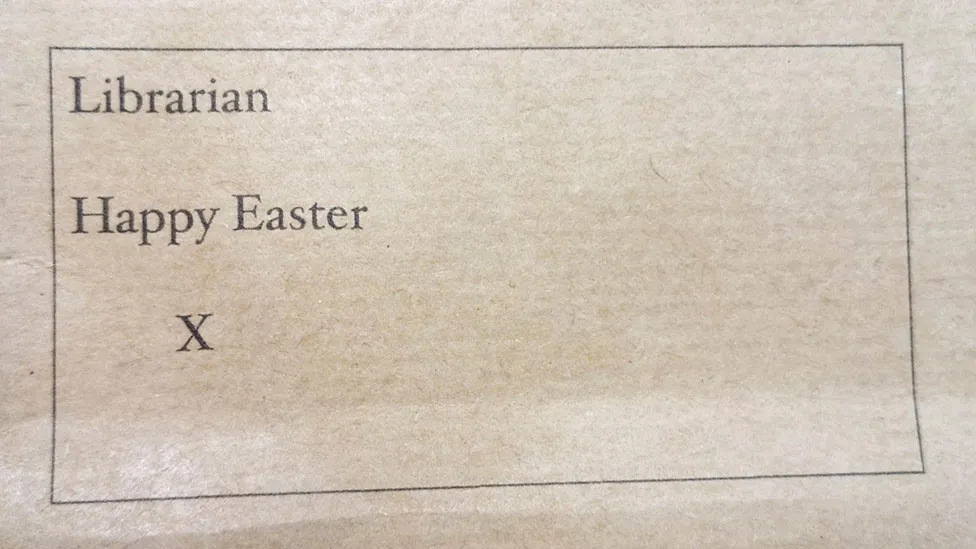
Happy Easter, Librarian!


Mysterious Message, left by the perpetrator

A remorseful thief repented last Easter (2022) and made amends. Whatever selfish urges which prompted them to plunder Cambridge University Library, appropriating for personal pleasure part of our common historical patrimony, was expiated in an act of remorse and restitution. Wow! - one doesn’t usually get to use words like those in a blog dedicated to science. But my guess is that the perpetrator was probably steeped in such language – it was Cambridge after all, and the Easter message is a bit tell-tale.

And a great joy it was to anyone interested in the culture and history of science! (To hard scientists, it’s the idea, not the original physical manifestation in ink and paper, that’s the thing.) The story is well told here and the joy that all-manner-of-things-were-wellis communicated in a video interview by Chief Librarian Dr Jessica Gardner. The timing was also a marvel, being in the final year of the Darwin Correspondence Project, a titanic effort to put 15,000 items of correspondence on line (I used it today!).

And such was that joy that, with a little persuading and ideation with a young historian of science academic at Darwin College, Edwin Rose, that the idea of a celebratory concert was born, including my string quartet on Darwinian themes. CUL via the Darwin Correspondence Project stumped a little money which gave rise to the concert which began this blog. It is sanely difficult to get new music programmed /performed from an unusual source. Sanely? Yes, because of the vast back-catalogue, and perfectly proper (albeit mean) funding/support structures for contemporary professional composers. So, usually, no chance to get music like this performed.

The concert, superbly programmed by Francis Knights, took place on 29th October 2022. It was a great chance to visit the exhibition of DCP at the Library – wonderful, touching examples of the correspondence, including with the fine minds in the British Public at the time such as the Stonemason’s letter (your time will be richly rewarded by clicking on this). The exhibition is now moving to the New York Public Libraries and runs through the summer.

So it is with thanks to the Repentant Thief, CUL and DCP, and Darwin College for the opportunity to visit the exhibition and to have a funded performance of Eyenigma Variations. See Darwiniana tab for photos, quotes and links to the music. I will post more music next time, related to Darwin’s examinations of coral reefs!

And Happy Easter to you; we come from many traditions and all are to be valued, examined, and celebrated.


Thursday, 26 January 2023

The Super Ape: date change!


...Is Us. Reggae, Dub & performance poetry below

Last post, I’d just been asked to give a talk for International Darwin Day at the University of East Anglia, Norwich, Quadram Institute on 13th Feb (date change from 10th due to INDUSTRIAL ACTION). This free event has now been posted (LINK SHOWS INCORRECT DATE, but booking site will be fine) as one of seventeen events from Brazil, Mexico (US x 8), through Germany and Novosibirsk, Russia (more on this excellent group later). I’ll be giving a talk inspired by the cult classic Gödel, Escher, Bach (Hofstadter, 1979) - about codes in music and how DNA can be represented, drawing on other composers’ efforts and using a useful trick from my biochemical past! A fair amount of genetics with a bit of music-theory added. I’ll be posting a new music video on Soundcloud to mark the occasion.

The event, organised by Profs. Tracey Chapman & Mark Pallen, will feature talks on “The ghost in the garden: in search of Darwin’s lost garden” (Dr Jude Piesse) and “The Call of the Wild: the genomic history of wolves and dogs” (Dr Anders Bergstrom). Mark is an international expert on high-throughput sequencing to problems in microbiology and ancient DNA research, and old hand at giving popular lectures on Darwin & Evolution. Here’s a saucy one from the Institute’s 2020 Darwin Day events, giving all the scuttlebutt (lovely American term) you’ll ever need on C.D. He’s also the author of the Rough Guide to Evolution (2008) which contains a section on music related to Darwin. A lot has happened since 2008 (stimulated by the 150th anniversary of ‘Origin’ in 2009) so probably will need an update; but in the meantime it’s a main theme of this blog so keep on reading!

One delight of finding all this science-arts-culture fostered by Tracey & Mark at Quadram was discovering performance poet (& science-writer, &&&…) Peter Bickerton, the Juggling Doctor. Peter gave a great reading of his piece Super Ape at Quadram in 2019, a video of it here. Wow, in a grand sweep (see my blog entry Arthur C. Clarke for comparison), he arcs our story from big-bang to extinction. Millenial-millenarianism?  Why not? Of course it’s painted in topical concerns, images and thought-patterns of our age (whadja want? Biblical style?), but that’s what gives it colour and fun; oh, and the really cool Jamaican Reggae / Dub from The Upsetters (1976). In a blog whose twin themes are evolution and music this was a great find. I’ll post at a later date about more Evolution-Dub!


Tuesday, 17 January 2023

Un-Darwin Day – today 17th Jan 2023?


Small Families, Hou Hai Lake Park Beijing 2018, DG 

It’s less than a month before International Darwin Day – his birthday on 12th February.  I’ve been asked to give a talk at the Qaudram Institute on 10th February entitled ‘The EyenigmaVariations: Darwin, DNA and Music’ and am planning a whole series of musical posts around that.

But (uniting both themes of this blog) today, 17th January 2023, has a good claim to be ‘Un-Darwin-Day’. Natural Selection as defined by Darwin (his words) requires “Ratio of Increase so high as to lead to a Struggle for Life, and as a consequence to Natural Selection…” Today marks continued confirmation that “Ratio of Increase so high…” is functionally over in this phase of our species - with the expected news of numerical fall in that byword for population enormity, China.  All countries will follow, in time. Take a look at the chart of  births per 1,000 people since the one-child policy ended in 2016: down, down, down. This is a social phenomenon, not a legal one, which is why everywhere else will follow. In fact, my ‘no-worries’ projection of the (temporary)extinction date of the human race, 5,400 C.E. (A.D.) assumes an increase of China’s current TFR (total fertility rate) of 1.45 to a world average of 1.6 (the current average for OECD countries). But, no worries! Still thousands of years of culture to go and maybe some big adventures.

Darwin of course anticipated that the human race had departed from fully Natural Selection, whatever its explanatory powers for how we’d got here (including his charming explanation of different skin colourations via the part which sexual selection plays in many species, itself an adaptive trait). The main force was another adaptive trait: that of caring for weaker members of society - the protective urge which he had observed in other social animals. A far cry from the winner-takes-all mentality that lesser minds took as a lesson from the simple mathematical ‘Special Theory’ of Natural Selection - a nicer ‘General Theory’.

And maybe we’ll need fewer humans, even in the cultural spaces we hope will be our preserve after the ‘end of work’. Here’s a scary story (same date, 17th Jan 2023) that could narrow the evolutionary niche of song-writers, composers etc, and the rest of us.

I’ll write further about Un-Darwin-Day with other candidate dates, and reasons to celebrate it, on a later occasion!

Picture credit: DG, at a popular park in Beijing for family outings, business trip 2018 (Semiconductor equipment business).

Wednesday, 16 November 2022

Eyenigma Variations – Extract on Soundcloud!

Following the marvellous performance of Eyenigma Variations at Darwin College Cambridge on 29th October by a quartet led by Paul Warburton, I’ve had many requests to hear the piece.  The concert ‘The Darwins and Music’ was a miracle of organisation with so many memorable elements – but too complex for a recording to take place, or to be fair to the musicians who gave their time serving up this wonderful collection of Darwin-related music.

Now Eyenigma has had its public premier, in the company of pieces by Cheryl Frances-Hoade, Haydn, Fanny Mendelssohn, Frédéric Chopin and Ralph Vaughan-Williams, it’s probably time to put and extract on Soundcloud (‘robot rendition’ directly from the software).  I’ve chosen the smokey ‘Tranquillo’ section through to the frenetic end, with warring codes and a final genetic STOP!  You’ll miss out on the mysterious beginning ‘Morse Codes and Torchbeams’ (flashlights!) and Variations on an anti-evolution hymn, but so soon after hearing flesh-and-blood musicians bring the whole thing to life I haven’t the heart to let the robots play the whole thing.

The Tranquillo is one of my favourite sections.  It was originally a vocal passage setting Darwin’s words describing how the Eye might have come to be, “from one very imperfect and simple” and so gets a very simple and calm melody.  The ‘cello comments on this and then adds the genetic code setting of the Eye protein rhodopsin, eventually rising up the scale – of complexity?  The violent and feroce coda reprises all the themes, but just audio lacks the fun of seeing the quartet really physically attacking the last few bars!

Hopefully if this gets a few hits (and comments!) I’ll add more clips to Soundcloud, including the (rendered) vocal/classical guitar settings “Glories of the Vegetation of the Tropics”, “I Gradually Came to Disbelieve” etc, and maybe some of the larger works.


Picture credit: Roland Deschain

Tuesday, 1 November 2022

'The Darwins and Music' - what a concert! 29/20/22


David with quartet members Paul, Bruce, Juliet, Helen and concert organiser Francis Knights


Fabulous concert ‘The Darwins and Music’ at Darwin College, Cambridge on Saturday 29th October, brilliantly put together by historian of science Edwin Rose and Francis Knights, head of music at the college. So many wonderful choices of music to illustrate talks on various Darwin generations, and great performances by the string quartet, Trinity Street Consort (led by Tammas Slater), Carola Darwin (soloist) and Marie-Noëlle Kendall (piano).

The quartet (Paul, Bruce, Juliet and Helen) gave the first public performance of Eyenigma Variations to a capacity audience of ~200 and played with great spirit and physicality, from the mysterioso beginning (the mystery of how Evolution could account for The Eye) to the ff feroce (fierce…) final bars, closing the argument. Given the fabulous other music on offer, from Cheryl Frances-Hoade and Francis Knights to Chopin and Vaughan-Williams (a Wedgewood-Darwin), I was delighted with the excellent performance and with the audience reaction.

I'd taken the opportunity earlier to go round the Darwin Correspondence Project exhibition at Cambridge University Library (joint sponsors of the concert) to see absolute gems of letters and communications casting a lovely light on this most likeable of scientists, the fascinating intellectual web of which he was the centre and his relations with family and the public (and also the famous Tree of Life - purloined & returned! - notebooks). I hope I’ve done some justice to the human aspects that came across in the letters in my ‘Three Soliloquies’ for baritone and guitar (see Darwiniana tab).

NB: no recording was possible due to the complexities and multi-strand nature of the concert.


Thursday, 20 October 2022

Eyenigma Variations first public performance


Eyenigma Variations: first public performance Saturday 29th October 2022 at Darwin College Cambridge

I'm delighted to say that the first public performance of 'Eyenigma Variations' (1.1) will take place at: The Darwins and Music: A Concert (Darwin College), Cambridge University Library as part of and with the support of Cambridge University Libraries exhibition, Darwin in Conversation: The Endlessly Curious Life and Letters of Charles Darwin (Saturday 9 July-Saturday 3 December). 

If you are attending and want to hum along with some of the sections based on Chapter 6, 'Origin of Species' (First Edition), the phrases depicted in music are: 

"Difficulties on the theory"- this becomes an opening rhythm in 'Morse Code': you can mutter along to this in a worried fashion. 

"To suppose that the eye with all its inimitable contrivances [pizzicato] for adjusting the focus to different distances, for admitting different amounts of light, and for the correction of spherical and chromatic aberration, could have been formed by natural selection, seems, I freely confess, absurd in the highest degree. [dance] Yet reason tells me, that if numerous gradations from a perfect and complex eye to one very imperfect and simple, each grade being useful to its possessor, can be shown to exist... [tranquillo]" 

."..the difficulty of believing that a perfect and complex eye could be formed by natural selection...and may we not believe that a living optical instrument might thus be formed as superior to one of glass, as the works of the Creator are to those of man? [coda]" 

It's 'music a scientist might write': I hope you like it.

Monday, 17 October 2022

Eyenigma Variations: A Fantasia on Codes for String Quartet


‘Eyenigma Variations’ quartet is based on themes from my choral settings of passages from Origin of Species, Voyage of the Beagle and Autobiography by Charles Darwin. I began collecting them in March 2008 when, after hearing a modern concert setting of a bloodthirsty passage from Isaiah, a Guardian pamphlet reproducing famous passages from the Origin literally dropped into my lap. I wondered why no-one had – apparently – tried to set the grandeur of Darwin’s world view in a musical context. 

Darwin faced head-on the gravest ‘Difficulties on the Theory’ in Chapter VI of Origin: ‘Organs of Extreme Perfection’ – of which the Eye was his prime example, the equivalent of Paley’s watch. I found a musical start-point in mid-Victorian creationist hymns, written to counter the free-thinking evolutionist current of the time. Darwin had no clear idea of a mechanism of heredity and variation and had to rely on an intellectual faith that something would turn up ex machina. He posits that an eye ‘very imperfect and simple’ might have existed: and we now know the simplest version would be a photoreceptor protein such as rhodopsin. On hearing the bell-ringers of my local church I was reminded of G’s, A’s and C’s used to notate both the musical scale and the genetic code and looked up the published code sequence for rhodopsin. 

Rhodopsin photo-receptor protein
 

The genetic code is arranged in threes – which give a natural jig or waltz rhythm.  Guanine, Adenine and Cytosine give an obvious mapping of G,A,C, but Thymine is a free choice. I thought that T sounded like ‘Ti’ in do-re-mi which would be ‘B’ in C-major: hence G,A,B,C.  To make it more musical and avoid the tedium of the apparently random natural sequence, I used a feature of the genetic code which allows mutation without changing the end result. It is usually possible to change the third letter (or note) in every three and still produce a valid ‘variation’ on rhodopsin, but one staying in a musical harmony! So a short section of the eye-protein sequence could produce melody, harmony and rhythm. 

I saw a delicious opportunity for a dialogue between mutations on a creation-upholding hymn-tune, Bright and Beautiful, and a theme derived from a genetic explanation for something Darwin had to take on faith: that there was an underlying encoding to explain heredity and variation. The association of codes with music, especially the insertion by BACH of his own name in The Art of Fugue (celebrated by Douglas Hofstadter in Gödel, Escher, Bach), seemed to demand its place to represent the traditional world-view, given Bach’s central place in faith-based music. And so the various coded musical elements in Eyenigma engage in a continuing debate, for which a string quartet seemed the most appropriate form. The work ends in closing statements from both sides with the BACH theme providing the final cadence but finishing in the final bar with my note-rendition of Thymine, Adenine, Guanine (T-A-G): the genetic code for STOP, THE END.

‘Eyenigma’ was performed amongst the dinosaurs in the Oxford Museum of Natural History in September 2015 at a private university function with the generous help of Professor Ian Brown, and honouring the famous Oxford Debate of 1860 which took place in the same building. 


Where do you look for E.T.? My paper on just that published in Acta Astronautica

  Published in Acta Astronautica June 2025, open access till end July Can there be any answer to that question that makes sense? We’ve been ...